SAP Business One Integration Challenges
(And How to Solve Them)

If you’re running SAP Business One, you already know it’s a powerful ERP platform built for small to medium-sized businesses. It handles your financials, inventory, purchasing, and more, all in one place. And with recent enhancements, SAP B1 has become increasingly capable of supporting more complex, higher-volume operations as companies grow. But regardless of where you are in that journey,  SAP Business One rarely operates in isolation. You’re connecting it to eCommerce platforms, 3PLs, EDI trading partners, CRMs, and a growing list of other systems.

And that’s where things get complicated.

ERP integration is one of the most common sources of frustration for SAP Business One users. What looks simple on paper turns into a project with hidden complexity, unexpected costs, and ongoing maintenance headaches. SAP Business One does include its own middleware tool, the B1 Integration Framework (B1if), but most businesses quickly discover it’s complex to configure, sparsely documented, and not built for the volume or variety of integrations a growing company needs.

In this guide, we’ll walk through the most common SAP Business One integration challenges businesses face, and more importantly, how to solve them without losing time, money, or your sanity.


Manual Data Entry Between Systems 

The Challenge 

One of the most widespread problems for SAP Business One users is still shockingly manual: employees re-keying data from one system into another. Orders come in through your eCommerce store or from a trading partner, and someone on your team manually enters them into  SAP B1. Invoices generated in SAP get manually transferred to a customer portal. Inventory updates don’t sync automatically, so your team is constantly reconciling spreadsheets.

This isn’t just inefficient. It’s a liability. Manual data entry introduces errors, causes fulfillment delays, and makes it nearly impossible to scale operations without adding headcount. What compounds this for  SAP B1 users specifically is that the platform runs on two different database engines, SAP HANA and Microsoft SQL Server, and the database your company is on directly affects how data is read and written during integrations. A connection that works on one database version may behave differently on the other, adding another layer of unpredictability to any integration project.

The Solution 

Automating the flow of data between SAP Business One and your other platforms eliminates this bottleneck entirely. With a purpose-built ERP integration platform, orders, invoices, inventory levels, and shipping confirmations can flow automatically between systems in real time, with no human touch required. The result is fewer errors, faster processing, and a team that can focus on higher-value work.

EDI Compliance with Trading Partners

The Challenge 

If your business works with large retailers, distributors, or suppliers, there’s a good chance they require EDI (Electronic Data Interchange). EDI is the standard format for exchanging business documents like purchase orders (850), invoices (810), and advance shipping notices (856) electronically.

The problem is that EDI compliance is technically demanding. Each trading partner has its own requirements, maps, and testing procedures. Keeping up with onboarding new partners, managing document maps, and staying compliant with changing requirements can quickly become a full-time job, or an expensive outsourced contract.

Connecting EDI directly to SAP Business One adds another layer of complexity. Many businesses end up with a fragile patchwork of manual processes and outdated middleware that breaks every time something changes.

The Solution 

A modern EDI automation platform built specifically for SAP Business One handles the complexity for you. Instead of managing raw EDI files and custom maps yourself, the platform translates EDI documents into SAP-ready transactions automatically. New trading partner onboarding becomes a matter of days rather than weeks, and ongoing compliance updates are managed on your behalf. Your SAP B1 environment stays clean, and your team doesn’t need to become EDI experts.

Connecting SAP Business One to eCommerce Platforms 

The Challenge 

Whether you’re selling on Shopify, WooCommerce, Magento, or a B2B portal, keeping your SAP Business One data in sync with your online storefront is a constant battle. Product information, pricing, inventory levels, order status, and customer data all need to flow between systems accurately and in real time.

Without proper integration, you end up with overselling because inventory isn’t syncing, delayed order fulfillment because orders aren’t flowing into SAP automatically, and frustrated customers who can’t get accurate shipping updates.

Building a custom API connection between SAP B1 and an eCommerce platform sounds straightforward but often requires significant developer resources, ongoing maintenance, and breaks whenever either platform updates. This is particularly acute for SAP B1 users because many small to medium businesses are still running older versions of the platform (9.x and 10.x), where major version upgrades can break existing add-ons and integrations entirely, forcing costly rebuilds at the worst possible time.

The Solution 

Pre-built connectors for popular eCommerce platforms eliminate the need for custom development. A purpose-built ERP integration platform maps your product catalog, pricing rules, inventory, and order data between your storefront and SAP Business One automatically. Changes made in SAP reflect on your website in real time, and orders placed online flow directly into SAP for processing with no manual steps or delays.

3PL and Warehouse System Integration 

The Challenge 

Many small to medium businesses using SAP Business One rely on third-party logistics providers (3PLs) or warehouse management systems (WMS) to handle fulfillment. The challenge is getting SAP and your 3PL to communicate effectively.

When these systems aren’t integrated, your team is stuck emailing spreadsheets back and forth, manually updating shipment statuses in SAP, and chasing down inventory discrepancies. This creates blind spots in your supply chain and makes it difficult to give customers accurate delivery information.

The Solution 

Integrating your 3PL or WMS directly with SAP Business One means shipment confirmations, tracking numbers, and inventory updates flow automatically into your ERP. You gain full visibility into your fulfillment pipeline without relying on manual communication with your logistics partners. When your 3PL ships an order, SAP knows about it immediately.

Scalability as You Add Trading Partners and Channels 

The Challenge 

What starts as a single integration, such as connecting SAP B1 to one retailer’s EDI system, and it quickly grows. New trading partners get added. You launch a new sales channel. You bring on a new 3PL. You start selling internationally.

Each new connection adds complexity, and if your integration approach isn’t built to scale, you end up with a tangled web of point-to-point connections that are expensive to maintain and nearly impossible to troubleshoot when something breaks.

The Solution 

The key is building on an integration platform that acts as a central hub for all your connections, rather than managing individual point-to-point integrations. With a hub-and-spoke model, adding a new trading partner or sales channel doesn’t mean building a new integration from scratch. This matters especially now, as SAP Business One has grown significantly more powerful and scalable with recent releases, meaning the platform itself is no longer the ceiling. The integration layer is. The right platform handles the translation and routing logic, and your SAP Business One environment stays stable regardless of how many connections you add.

Lack of Visibility and Error Monitoring 

The Challenge 

Even when integrations are running, many businesses have no visibility into what’s actually happening. Did that order make it into SAP? Why is there a discrepancy in this invoice? Where did that shipment confirmation go?

Without proper monitoring, errors go undetected until they cause a bigger problem: a missed shipment, an unhappy customer, or a compliance failure with a trading partner.

The Solution 

A modern ERP integration platform provides a real-time dashboard where you can see the status of every transaction flowing between your systems. Errors are flagged immediately with clear descriptions, so your team can resolve issues before they escalate. Instead of hunting through logs or emailing your IT team, you have complete transparency into your integration activity at all times.

High Cost of Custom Development and Maintenance

The Challenge 

Many businesses initially try to solve integration problems with custom development by hiring developers to build API connections or write custom scripts. This approach often works in the short term but becomes expensive quickly. For SAP Business One users, this is especially true because B1 exposes two integration APIs: the DI API and the newer Service Layer, introduced in version 9.2. Most integrations rely on the DI API, which provides deep, reliable access to SAP B1 data, while the Service Layer serves as an alternative for specific environments such as SAP-hosted databases. Navigating which API applies to your setup, and building a custom integration around it, adds significant time and cost to any development project.

Every time SAP Business One releases an update, every time a trading partner changes their EDI specs, every time a connected platform releases a new version, your custom code needs to be updated. Developer time is expensive, timelines are unpredictable, and the business becomes dependent on specific individuals who understand the custom setup.

The Solution 

A managed ERP integration platform shifts the maintenance burden away from your internal team. Updates, mapping changes, and platform compatibility are handled by the integration provider, not your developers. The total cost of ownership is predictable, and you’re not left scrambling every time something in your technology stack changes.

How Alluvia Solves SAP Business One Integration 

Alluvia is built specifically for businesses running SAP Business One, whether you’re a small business managing your first integrations or a growing company taking advantage of SAP B1‘s expanding capabilities. Our platform handles EDI automation, eCommerce integration, 3PL connectivity, and more, all through a single, easy-to-manage hub.

Unlike generic iPaaS platforms that require heavy configuration, Alluvia comes with pre-built connectors and managed onboarding so you can go live faster and with less internal effort. Our team handles the complexity so yours doesn’t have to.

If you’re dealing with any of the challenges above, we’d love to show you how Alluvia works.

Book a Demo Today and see how we can simplify your SAP Business One integrations.

question zone

Frequently Asked Questions

/ 01
What is SAP Business One integration?

SAP Business One integration refers to connecting your SAP B1 ERP system to other business platforms such as eCommerce stores, EDI trading partners, 3PLs, CRMs, or marketplaces — so that data flows automatically between them without manual intervention.

/ 02
Why is SAP Business One integration challenging?

SAP Business One uses its own data structures and APIs, which don’t always align with the formats used by external systems. EDI trading partners have unique requirements, eCommerce platforms have their own data models, and custom development is expensive and hard to maintain. Purpose-built integration platforms solve these challenges by handling the translation and routing logic automatically.

/ 03
What is EDI and why does it matter for SAP Business One users?

EDI (Electronic Data Interchange) is the standard format used by large retailers, distributors, and suppliers to exchange business documents electronically. If your trading partners require EDI, you need a way to translate those documents into SAP Business One transactions automatically. Without proper EDI integration, your team ends up managing the process manually, which is slow, error-prone, and hard to scale.

/ 04
How long does it take to integrate SAP Business One with a trading partner?

With a purpose-built platform like Alluvia, new trading partner onboarding typically takes three to four weeks rather than months. Traditional EDI setups can take much longer because of manual mapping and testing requirements, but modern platforms streamline the process significantly.

/ 05
Can I connect SAP Business One to Shopify or other eCommerce platforms?

Yes. Alluvia offers pre-built connectors for popular eCommerce platforms including Shopify, WooCommerce, and Magento. These connectors sync inventory, orders, pricing, and customer data between your storefront and SAP Business One in real time.

/ 06
Do I need a developer to manage SAP Business One integrations?

Not necessarily. A managed integration platform handles the technical complexity, including mapping, maintenance, and updates, on your behalf. Your team can monitor integration activity through a dashboard without needing deep technical knowledge.

/ 07
What's the difference between a point-to-point integration and a hub-and-spoke model?

A point-to-point integration connects two systems directly, which works for simple setups but becomes difficult to manage as you add more connections. A hub-and-spoke model routes all your integrations through a central platform, making it much easier to add new trading partners, channels, or systems without rebuilding everything from scratch.

/ 08
How does Alluvia support SAP Business One users specifically?

Alluvia is purpose-built for businesses running SAP Business One, from small companies getting their first integrations off the ground to growing operations leveraging SAP B1’s newer capabilities. We offer pre-built connectors, managed EDI onboarding, real-time monitoring, and a dedicated support team that understands the specific challenges SAP B1 users face. Our platform is designed to go live quickly and scale as your business grows. Request a demo to see it in action.

image alt
Get Started

Stop losing money to errors and chargebacks.

Free your ERP team from data entry and start scaling smarter. Automate your EDI workflows, cut errors, and boost efficiency.

Unitex International Transforms EDI and Ecommerce Operations with Alluvia

About Unitex International, Inc.

Unitex International, Inc. is a manufacturing and wholesale distribution company operating across a mix of large retail customers and ecommerce channels. The company supports high-volume order fulfillment through both traditional retail relationships and online sales platforms, requiring reliable coordination across multiple systems and workflows.

Operating across this diverse channel mix requires accurate, reliable, and timely order, shipment, and invoicing workflows. To support this complexity efficiently, Unitex relies on automated EDI and ecommerce integrations to maintain consistency and control across all channels.

Retail EDI and ecommerce automation

The Challenge

As Unitex International expanded across multiple retail and ecommerce channels, managing order processing became increasingly complex. Each EDI trading partner introduced unique requirements for orders, advance ship notices, invoices, and other EDI documents, along with strict compliance rules and timing expectations.

A key challenge involved auto-packed orders, where shipment details such as carton structure, quantities, and labels are generated automatically by warehouse systems and must align precisely with EDI requirements. Any mismatch between packing data, shipment notices, and invoices could result in transaction failures, delays, or downstream operational issues.

At the same time, growing ecommerce order volume added pressure to a lean operations team. Failed transactions and data issues required manual troubleshooting and reprocessing, slowing fulfillment and increasing risk. Unitex needed a dependable solution that could support complex EDI trading partner workflows and ecommerce operations while keeping processes predictable and manageable.

The Solution

Alluvia provided Unitex International with a centralized EDI platform integrated with SAP Business One.

Using Alluvia, Unitex is able to receive orders, generate shipment notices, submit invoices, and manage additional EDI documents across its EDI trading partners and ecommerce channels. The platform supports auto-packed workflows, ensuring carton structures, quantities, and shipment details are accurately reflected across EDI documents.

Built-in validation and exception handling ensure transactions meet trading partner requirements before they are processed. When issues occur, the team can quickly diagnose errors and repost failed transactions, allowing fulfillment to continue without disruption. Combined with Alluvia’s responsive, white-glove support, Unitex gained confidence in managing complex, multi-channel EDI requirements on a daily basis.

Bottom Line

By using Alluvia, Unitex International improved efficiency across its EDI and ecommerce operations. Manual work was reduced, order processing became more predictable, and the team saved valuable time each day.

Issues were resolved faster, workflows stabilized, and operations across retail and ecommerce channels became easier to manage. With reliable automation and hands-on support in place, Unitex was able to meet demanding EDI trading partner requirements without adding operational strain to a small team.

“Alluvia is a dependable EDI VAN and exactly what we need as a growing mid-market company. It makes my team more efficient, more productive, and truly worry-free.”

— Nid Keophila, Office Manager, Unitex International, Inc

Why Alluvia

For Unitex International, Alluvia delivered more than EDI connectivity. The combination of dependable technology and responsive support made a measurable difference in daily operations.

When issues occurred, Alluvia’s team helped quickly diagnose problems and supported the reposting of failed transactions, keeping critical EDI workflows moving without disruption. Alluvia’s professionalism and white-glove service allowed Unitex to operate with confidence while supporting multiple EDI trading partners and ecommerce channels.

Key Takeaways

  • Centralized EDI management across retail and ecommerce channels
  • Support for complex EDI trading partner requirements, including auto-packed shipments
  • Reduced manual work and operational friction
  • Faster resolution of failed transactions
  • Reliable white-glove support for a lean operations team
image alt
Get Started

Smart Solutions Start with Simplicity

Let us show you how quickly you can connect your ERP to ecommerce and marketplace systems using a simple drag-and-drop mapping interface powered by flexible integration architecture. Alluvia is a plug-and-play solution at a cost you can control.

Industrial Ecommerce in Motion: SAP Business One, Shopify, and ShipStation Synchronizing Bowman’s Global Shipments

About Bowman International

Bowman International is a global engineering and manufacturing company specializing in bearings and motion control products. Alongside its ERP-driven operations, Bowman supports a growing ecommerce presence that requires tight coordination between order management, shipping, and fulfillment systems.

To support both ERP and ecommerce workflows at scale, Bowman relies on accurate, real-time data flow between SAP Business One, its ecommerce storefront, and shipping platforms. This integration is critical to ensuring orders move efficiently from purchase through shipment without manual intervention.

The Challenge

Bowman International needed a reliable way to connect SAP Business One running on SAP HANA with its ecommerce and shipping systems to support daily operations. Orders originating from its ecommerce storefront needed to flow seamlessly into SAP Business One, while shipment execution and tracking data needed to be accurately synchronized across systems.

Without a stable integration layer, maintaining consistency between ERP, ecommerce, and shipping created unnecessary complexity. Shipment processing required careful oversight, and limitations in the previous setup made it difficult to scale ecommerce order volumes while maintaining accuracy and reliability across fulfillment workflows.

Bowman required an integration solution that could connect ERP, ecommerce, and shipping into a single, dependable flow that operated continuously throughout the day.

The Solution

Alluvia implemented an automated integration layer connecting SAP Business One, Shopify, and ShipStation, enabling end-to-end data flow across ecommerce, ERP, and shipping operations.

Ecommerce orders placed through Shopify are automatically synchronized with SAP Business One, ensuring order data remains accurate and consistent. Shipment information is then sent from SAP Business One to ShipStation, where labels and carrier processing are handled. Once shipments are completed, tracking and shipment data is automatically returned to SAP Business One.

This automated flow ensures Bowman’s ecommerce, ERP, and shipping systems remain fully aligned without manual handling. The integration runs continuously throughout the day and supports every shipment processed, including high-volume FedEx shipments.

Alluvia was selected based on its proven track record with these platforms and a direct recommendation from ShipStation, giving Bowman confidence in both performance and long-term scalability.

Bottom Line

By automating the connection between SAP Business One, ecommerce, and shipping systems, Bowman International significantly improved efficiency across its fulfillment operations. Orders flow cleanly from ecommerce into ERP, shipments are processed reliably, and data is synchronized automatically across all platforms.

The result is meaningful time savings, improved workflows, expanded courier flexibility, and a more reliable shipping operation compared to previous software.

“Alluvia has become a critical part of our daily operations, seamlessly connecting SAP Business One with Shopify and ShipStation. It handles every shipment we process, saving us significant time while delivering a more efficient and reliable workflow.”

– Charles Martin-Bassett, Global Systems Engineer, Bowman International


Why Alluvia

For Bowman International, Alluvia provides more than point-to-point integrations. By serving as a centralized integration layer between ERP, ecommerce, and shipping systems, Alluvia enables Bowman to operate with confidence as order volumes scale.

Alluvia’s stability, platform expertise, and hands-on support ensure integrations remain dependable as requirements evolve. With SAP Business One, Shopify, and ShipStation fully synchronized, Bowman can focus on operations and growth rather than integration maintenance.


Question Zone

Frequently Asked Questions

No answer to your question? You can write us your question and we will answer as soon as possible.

/ 01
How does Alluvia integrate SAP Business One with Shopify and ShipStation?

Alluvia connects SAP Business One running on SAP HANA with Shopify and ShipStation through automated, real-time data flows. Ecommerce orders placed in Shopify are synchronized with SAP Business One, shipment details are sent to ShipStation for processing, and completed shipment data is automatically returned to SAP Business One to keep all systems aligned.

/ 02
How are ecommerce orders handled in this integration?

Ecommerce orders originating from Shopify are automatically transferred into SAP Business One without manual intervention. This ensures order data remains accurate and consistent across ERP, ecommerce, and shipping workflows.

/ 03
How does Alluvia support shipping operations?

Alluvia sends shipment information from SAP Business One to ShipStation, where labels and carrier processing are handled. Once shipments are completed, tracking and shipment details are returned to SAP Business One in real time. Every shipment Bowman processes runs through the Alluvia platform.

/ 04
How often does the Alluvia integration run?

The integration runs continuously throughout the day, supporting ecommerce order flow and shipping operations without manual data handling.

/ 05
What operational improvements did Bowman see after implementing Alluvia?

Bowman experienced significant time savings, improved workflow efficiency, expanded courier options, and increased reliability compared to previous integration software.

/ 06
Why did Bowman International choose Alluvia for this integration?

Bowman selected Alluvia due to its proven track record integrating SAP Business One with ecommerce and shipping platforms, as well as a direct recommendation from ShipStation.

/ 07
Is Alluvia suitable for ecommerce and high-volume shipping workflows?

Yes. Alluvia is designed to support high-volume, mission-critical ecommerce and shipping operations and has become a critical part of Bowman International’s daily workflow.

image alt
Get Started

Smart Solutions Start with Simplicity

Let us show you how quickly you can connect your ERP to ecommerce and marketplace systems using a simple drag-and-drop mapping interface powered by flexible integration architecture. Alluvia is a plug-and-play solution at a cost you can control.

From Jobsite to Digital: Jaydee Group Accelerates Construction Supply with Seamless EDI and Ecommerce

About Jaydee Group

Jaydee Group is a multi-channel distribution and ecommerce company serving the construction and building supply market. Operating across major retail and online sales channels, the company manages high-volume order, fulfillment, and data workflows that require accuracy, reliability, and scalability.

Running on SAP Business One, Jaydee Group relies on integrated EDI and ecommerce data flows to support daily operations and maintain consistent, predictable performance across retail and marketplace channels.

The Challenge

Jaydee Group supported its order-to-cash process through a combination of retailer EDI connections and ecommerce marketplace integrations connected to SAP Business One. While these systems were technically integrated, they required frequent manual intervention to keep data accurate and aligned across channels. Orders, invoices, shipment notices, and marketplace transactions often needed to be reviewed, adjusted, or reprocessed to meet the specific requirements of large retail and online partners.

As order volumes increased, this reliance on manual oversight became more disruptive. Fulfillment slowed, operational visibility decreased, and the risk of errors and chargebacks grew. Jaydee Group needed a more automated and dependable approach to managing EDI and ecommerce data flows within SAP Business One without adding complexity or increasing internal workload.

The Solution

Alluvia implemented an automated integration layer to streamline Jaydee Group’s retailer EDI and eCommerce workflows within its SAP Business One environment. Through prebuilt and configurable integrations, Alluvia automated the flow of orders, invoices, ASNs, and marketplace transactions across systems.

By removing manual handling and standardizing data flows, Alluvia ensured information moved accurately and consistently between Jaydee Group and its retail and ecommerce partners, including large home improvement and home goods retailers as well as high-volume online marketplaces. In addition, Alluvia’s ongoing white-glove support provided guidance and quick adjustments as partner requirements evolved, giving Jaydee Group confidence in the stability and scalability of its integrations.

Bottom Line

By automating retailer EDI and eCommerce workflows with Alluvia, Jaydee Group significantly improved the speed, accuracy, and reliability of its order processing. Manual corrections and exception handling that previously slowed fulfillment were reduced, helping the team minimize errors and avoid issues that could lead to chargebacks.

“Alluvia has significantly improved the speed and accuracy of our retailer EDI and ecommerce workflows. Before their platform, we spent too much time correcting errors and managing issues that slowed fulfillment and sometimes led to chargebacks. Since moving to Alluvia, our order flow has become far more stable and predictable, and their consistently helpful support team has made a clear difference in our day-to-day operations.”  Jaydee Group Inc.

In addition to automation, Alluvia’s responsive support team played a key role in maintaining reliable operations. Quick assistance and a deep understanding of Jaydee Group’s workflows ensured integrations remained dependable as retail and marketplace requirements evolved, creating a lasting positive impact on day-to-day performance.

Why Alluvia

Alluvia delivers more than automated EDI and ecommerce integrations. For Jaydee Group, the real value extended beyond technology to the quality of ongoing support and service. Whenever assistance was needed or a retail or ecommerce channel required an update, the Alluvia team responded quickly with a clear understanding of Jaydee Group’s SAP Business One environment and partner requirements.

This hands-on, white-glove approach ensured integrations remained reliable, accurate, and aligned with evolving demands from major retailers and online marketplaces. With deep technical expertise and a proactive support model, Alluvia became a trusted extension of Jaydee Group’s operations rather than just another vendor.

After working with multiple providers over the years, Jaydee Group found in Alluvia a rare combination of reliability, technical knowledge, and genuine responsiveness. That commitment to service allows Alluvia customers to operate with confidence, knowing their EDI and ecommerce workflows are fully supported at every stage.

image alt
Get Started

Smart Solutions Start with Simplicity

Let us show you how quickly you can connect your ERP to ecommerce and marketplace systems using a simple drag-and-drop mapping interface powered by flexible integration architecture. Alluvia is a plug-and-play solution at a cost you can control.

Stop Treating Your ERP Team Like Data Entry Bots: The True Cost of the Manual Effort Tax

Stressed sap b1 team

The Manual Effort Tax 

You invested in an ERP system to streamline operations, improve accuracy and give your team better visibility across the business.

But when EDI is still handled manually, the people who know your ERP best end up spending their days retyping information instead of doing meaningful work. The Manual Effort Tax shows up as lost productivity, higher chargebacks and teams who are overwhelmed by repetitive tasks. Every time someone re-enters an 850 Purchase Order or tries to rebuild an ASN by hand, they are pulled away from analysis, forecasting and the work that actually drives your business forward.

EDI integration is not only about compliance. It gives your ERP team the time and freedom to use the system for what it was built for smarter decisions and faster growth.

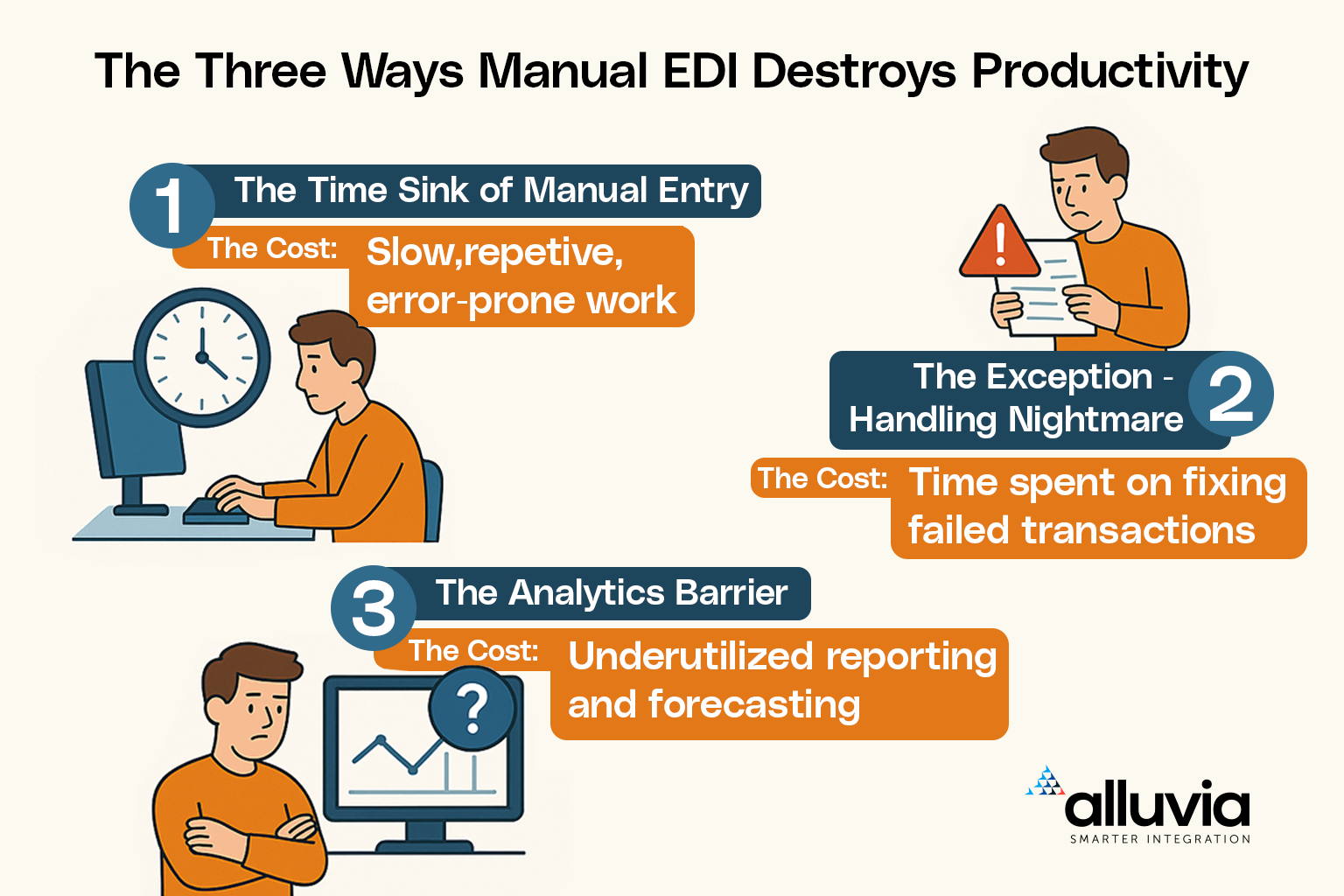
The Three Ways Manual EDI Destroys ERP Productivity 

Manual EDI slows down any ERP system

1. The Time Sink of Manual Entry

Manual EDI turns every document into repeat work.

  • Every 850 Purchase Order requires someone to key in every line.
  • Every 856 Advance Ship Notice requires typing tracking information, carton details and item quantities.
  • Every 810 invoice requires manual matching across several screens.

The Cost: Manual entry is slow and error prone. A single incorrect digit in a UPC, quantity or carton ID can trigger retailer chargebacks from companies like Walmart, Target , Home Depot, Staples, Wakefern, Macy’s or Amazon. Your team loses the time that could be used for planning, analysis or solving real problems rather than typing.

2. The Exception Handling Nightmare 

When manual EDI breaks, and it eventually will, your team becomes responsible for finding the issue. They move between ERP screens, spreadsheets and retailer portals to find inconsistencies.

The Cost: Your most knowledgeable employees, who understand your operations inside and out, end up spending hours chasing errors and reconciling data. They become gatekeepers of broken processes instead of optimizing inventory, improving vendor relationships, or analyzing performance trends across your business.

3. The Analytics Barrier 

Your ERP system is designed to give you powerful insights into performance, trends and forecasting. When EDI is manual, your team never has the time to use these tools the way they were intended.

The Cost: Your reports are incomplete, forecasting becomes less accurate and your data relies on manual typing instead of real automation. You end up with a modern ERP and outdated processes. The benefit of having a unified platform is lost when key operational data is still handled manually.

Automating your ERP + EDI With Alluvia Changes Everything 

When your ERP system and EDI are connected through Alluvia’s purpose-built integration platform, your team finally shifts from manual data work to strategic operations.


Feature  If EDI Is Manual  If EDI Is Automated with Alluvia 
Team Role  Data Entry, Corrections, Firefighting  Oversight, Strategy, Optimization 
Time Use  90% manual tasks,10% analysis  5% monitoring, 95% value-driven work
Data Flow  Slow, inconsistent, human-dependent  Real-time, validated, fully automated
Outcome  High chargebacks, frustrated team  Lower chargebacks, scalable operations 


Alluvia automatically pulls the right data from your ERP, maps it to compliant EDI documents, validates it against retailer requirements, and sends it without manual touch. Your team only gets involved when something truly needs their expertise. 

The Profit-Protection Power of Alluvia’s EDI Solution 

Alluvia is not a generic integration platform.
It is built specifically for ERP and EDI workflows.

Here’s how Alluvia eliminates manual EDI:

1. Zero-Touch ASN Generation (EDI 856) 

Alluvia monitors your ERP’s shipment documents in real time. As soon as an order is fulfilled and shipped, Alluvia automatically performs all the necessary steps: 

  • Pulls tracking numbers and shipment details. 
  • Reads carton IDs and validates quantities. 
  • Builds the ASN (Advance Shipping Notice) instantly. 
  • Sends the ASN to your retailer. 

This eliminates manual typing, portal logins, and the errors that lead to high-cost penalties. 

2. Built-In Retailer Compliance Rules

Every retailer imposes strict, non-negotiable requirements for 850s, 855s856s, and 810s. Alluvia includes out-of-the-box templates and validation rules for major partners like: Walmart, Target , Amazon, Whole Foods,  Home Depot, Staples, Wakefern, Macy’s, and thousands of tradings partners across retail, grocery, logistics, automotive and pharma.

Before any document is sent, Alluvia checks it against the retailer’s rules preventing chargebacks before they happen. 

3. Native Integration Across Your ERP Ecosystem 

Alluvia integrates with your ERP the way it is designed to operate: 

  • It supports key features like Item Masters, Warehouses, Batches, and UDFs in your ERP. 
  • It respects your specific pricing rules, taxes, and logistics workflows. 
  • The integration layer handles the complex EDI transmission, while your team continues working seamlessly within their familiar ERP environment. 

How Alluvia’s EDI Solution Works Across Different ERPs

Every ERP system structures data differently, which makes manual EDI increasingly difficult to manage as you grow. Alluvia is designed to work naturally with each system so your team keeps operating inside the ERP they already know while EDI runs automatically in the background.

SAP Business One (SQL and HANA): Alluvia integrates seamlessly with SAP Business One, leveraging UDFs (User Defined Fields) and supporting both DI-API and Service Layer for maximum flexibility. Whether you need custom field mapping or deep API connectivity, we ensure a smooth, native experience.

SAP S/4HANA: From IDocs to advanced S/4 HANA Rest APIs, Alluvia supports both integration methods across any logistics process. We adapt to your preferred approach while maintaining real-time, high-volume data flow for complex operations.

SAP Business ByDesign: Even as a legacy cloud ERP, Alluvia delivers full compatibility through the complete API and supports extension fields for custom workflows. We make ByDesign integrations effortless and future-ready.

SAP ECC: ECC’s rigid structure and IDoc-based logic can be challenging but not for Alluvia. We handle its legacy complexity with precision, ensuring clean integration without disrupting established processes.

Microsoft Dynamic BC : While BC’s native APIs lack robust custom field support, Alluvia bridges the gap with our own extended API framework, enabling full custom field integration. We go beyond limitations to deliver a truly flexible solution.

Oracle NetSuite:  NetSuite’s unique permission model and complex workflows require expertise and Alluvia has it. We work seamlessly within its architecture, respecting custom fields and saved searches without breaking your logic.

Acumatica: Acumatica’s flexible architecture supports both on-premise and cloud deployments. Alluvia integrates cleanly with its API framework, handling custom fields and workflows without disrupting your configurations.

Ready to Reclaim Your ERP Investment? 

Manual EDI is a hidden cost that grows with every new retailer, every order spike, and every exception. If you want your ERP team to be strategic not stuck doing data entry then your EDI workflows must be automated. 

With Alluvia’s EDI solutions, you can: 

  • Eliminate manual document creation 
  • Reduce chargebacks 
  • Improve compliance 
  • Speed up fulfillment 
  • Free your team for analysis and strategy 

All while using a tool built specifically for you. 

image alt
Get Started

Stop losing money to errors and chargebacks.

Free your ERP team from data entry and start scaling smarter. Automate your EDI workflows, cut errors, and boost efficiency.

We are saving an Additional $20,000 per Year with the help of Alluvia’s Integration Tools

About Artemide

Artemide is a global leader in lighting design, known for combining innovation, sustainability, and timeless aesthetics. With decades of expertise, Artemide develops high-performance lighting solutions that blend advanced technology with contemporary style for residential, commercial, and architectural spaces.

image alt
Get Started

Smart Solutions Start with Simplicity

Let us show you how quickly you can connect your ERP to ecommerce and marketplace systems using a simple drag-and-drop mapping interface powered by flexible integration architecture. Alluvia is a plug-and-play solution at a cost you can control.

From Manual Processes to Automation: West Coast Seeds’ Success with Alluvia

About West Coast Seeds

West Coast Seeds is a trusted supplier of premium, non-GMO seeds and gardening products for both home gardeners and commercial growers. With a focus on sustainability and education, the company provides a wide range of vegetable, herb, and flower seeds, along with tools and resources that promote healthy, successful growing practices.

image alt
Get Started

Smart Solutions Start with Simplicity

Let us show you how quickly you can connect your ERP to ecommerce and marketplace systems using a simple drag-and-drop mapping interface powered by flexible integration architecture. Alluvia is a plug-and-play solution at a cost you can control.