share the article:


The Manual Effort Tax
You invested in an ERP system to streamline operations, improve accuracy and give your team better visibility across the business.
But when EDI is still handled manually, the people who know your ERP best end up spending their days retyping information instead of doing meaningful work. The Manual Effort Tax shows up as lost productivity, higher chargebacks and teams who are overwhelmed by repetitive tasks. Every time someone re-enters an 850 Purchase Order or tries to rebuild an ASN by hand, they are pulled away from analysis, forecasting and the work that actually drives your business forward.
EDI integration is not only about compliance. It gives your ERP team the time and freedom to use the system for what it was built for smarter decisions and faster growth.
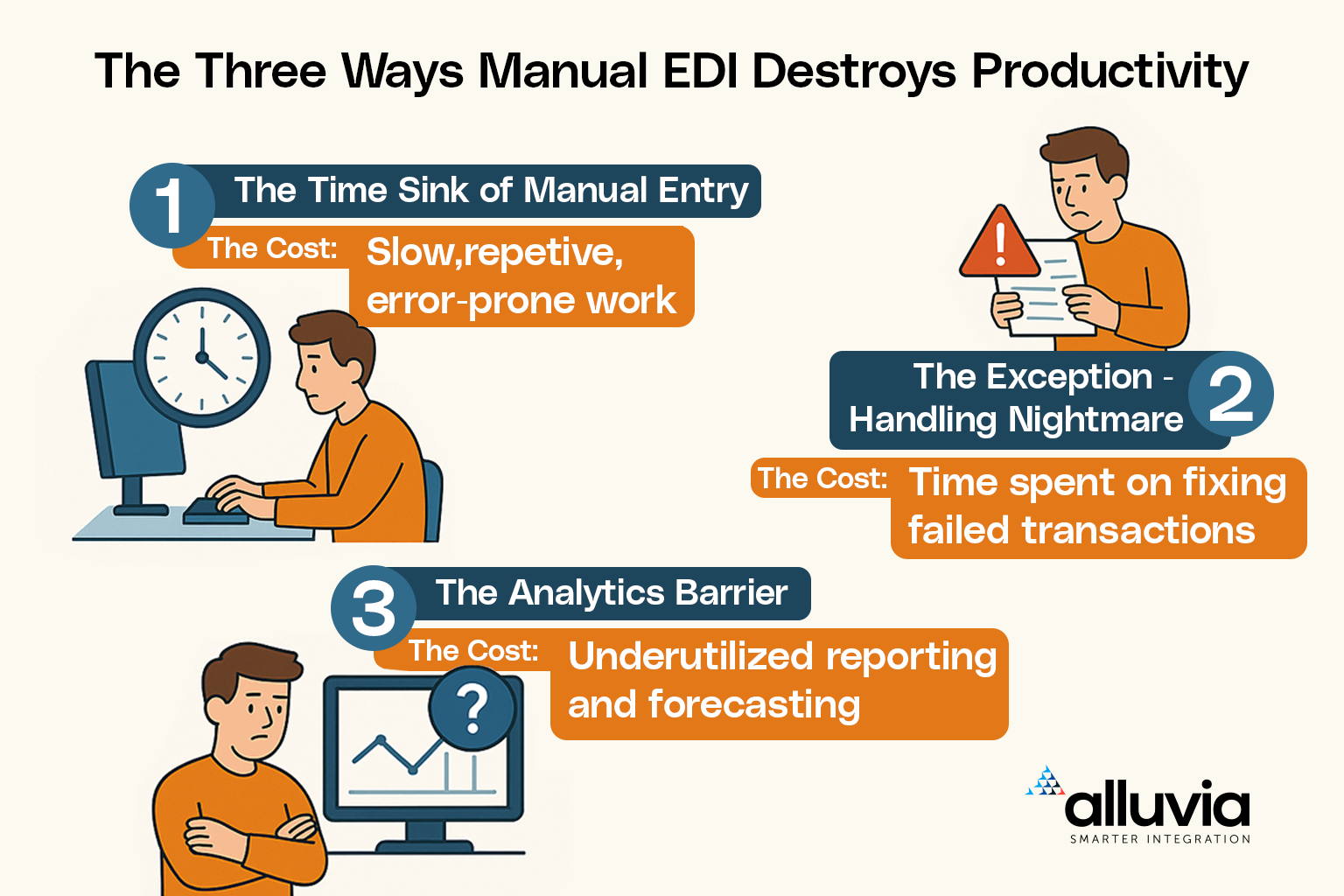
The Three Ways Manual EDI Destroys ERP Productivity
Manual EDI slows down any ERP system
1. The Time Sink of Manual Entry
Manual EDI turns every document into repeat work.
- Every 850 Purchase Order requires someone to key in every line.
- Every 856 Advance Ship Notice requires typing tracking information, carton details and item quantities.
- Every 810 invoice requires manual matching across several screens.
The Cost: Manual entry is slow and error prone. A single incorrect digit in a UPC, quantity or carton ID can trigger retailer chargebacks from companies like Walmart, Target , Home Depot, Staples, Wakefern, Macy’s or Amazon. Your team loses the time that could be used for planning, analysis or solving real problems rather than typing.
2. The Exception Handling Nightmare
When manual EDI breaks, and it eventually will, your team becomes responsible for finding the issue. They move between ERP screens, spreadsheets and retailer portals to find inconsistencies.
The Cost: Your most knowledgeable employees, who understand your operations inside and out, end up spending hours chasing errors and reconciling data. They become gatekeepers of broken processes instead of optimizing inventory, improving vendor relationships, or analyzing performance trends across your business.
3. The Analytics Barrier
Your ERP system is designed to give you powerful insights into performance, trends and forecasting. When EDI is manual, your team never has the time to use these tools the way they were intended.
The Cost: Your reports are incomplete, forecasting becomes less accurate and your data relies on manual typing instead of real automation. You end up with a modern ERP and outdated processes. The benefit of having a unified platform is lost when key operational data is still handled manually.
Automating your ERP + EDI With Alluvia Changes Everything
When your ERP system and EDI are connected through Alluvia’s purpose-built integration platform, your team finally shifts from manual data work to strategic operations.
| Feature | If EDI Is Manual | If EDI Is Automated with Alluvia |
|---|---|---|
| Team Role | Data Entry, Corrections, Firefighting | Oversight, Strategy, Optimization |
| Time Use | 90% manual tasks,10% analysis | 5% monitoring, 95% value-driven work |
| Data Flow | Slow, inconsistent, human-dependent | Real-time, validated, fully automated |
| Outcome | High chargebacks, frustrated team | Lower chargebacks, scalable operations |
Alluvia automatically pulls the right data from your ERP, maps it to compliant EDI documents, validates it against retailer requirements, and sends it without manual touch. Your team only gets involved when something truly needs their expertise.
The Profit-Protection Power of Alluvia’s EDI Solution
Alluvia is not a generic integration platform.
It is built specifically for ERP and EDI workflows.
Here’s how Alluvia eliminates manual EDI:
1. Zero-Touch ASN Generation (EDI 856)
Alluvia monitors your ERP’s shipment documents in real time. As soon as an order is fulfilled and shipped, Alluvia automatically performs all the necessary steps:
- Pulls tracking numbers and shipment details.
- Reads carton IDs and validates quantities.
- Builds the ASN (Advance Shipping Notice) instantly.
- Sends the ASN to your retailer.
This eliminates manual typing, portal logins, and the errors that lead to high-cost penalties.
2. Built-In Retailer Compliance Rules
Every retailer imposes strict, non-negotiable requirements for 850s, 855s, 856s, and 810s. Alluvia includes out-of-the-box templates and validation rules for major partners like: Walmart, Target , Amazon, Whole Foods, Home Depot, Staples, Wakefern, Macy’s, and thousands of tradings partners across retail, grocery, logistics, automotive and pharma.
Before any document is sent, Alluvia checks it against the retailer’s rules preventing chargebacks before they happen.
3. Native Integration Across Your ERP Ecosystem
Alluvia integrates with your ERP the way it is designed to operate:
- It supports key features like Item Masters, Warehouses, Batches, and UDFs in your ERP.
- It respects your specific pricing rules, taxes, and logistics workflows.
- The integration layer handles the complex EDI transmission, while your team continues working seamlessly within their familiar ERP environment.
How Alluvia’s EDI Solution Works Across Different ERPs
Every ERP system structures data differently, which makes manual EDI increasingly difficult to manage as you grow. Alluvia is designed to work naturally with each system so your team keeps operating inside the ERP they already know while EDI runs automatically in the background.
SAP Business One (SQL and HANA): Alluvia integrates seamlessly with SAP Business One, leveraging UDFs (User Defined Fields) and supporting both DI-API and Service Layer for maximum flexibility. Whether you need custom field mapping or deep API connectivity, we ensure a smooth, native experience.
SAP S/4HANA: From IDocs to advanced S/4 HANA Rest APIs, Alluvia supports both integration methods across any logistics process. We adapt to your preferred approach while maintaining real-time, high-volume data flow for complex operations.
SAP Business ByDesign: Even as a legacy cloud ERP, Alluvia delivers full compatibility through the complete API and supports extension fields for custom workflows. We make ByDesign integrations effortless and future-ready.
SAP ECC: ECC’s rigid structure and IDoc-based logic can be challenging but not for Alluvia. We handle its legacy complexity with precision, ensuring clean integration without disrupting established processes.
Microsoft Dynamic BC : While BC’s native APIs lack robust custom field support, Alluvia bridges the gap with our own extended API framework, enabling full custom field integration. We go beyond limitations to deliver a truly flexible solution.
Oracle NetSuite: NetSuite’s unique permission model and complex workflows require expertise and Alluvia has it. We work seamlessly within its architecture, respecting custom fields and saved searches without breaking your logic.
Acumatica: Acumatica’s flexible architecture supports both on-premise and cloud deployments. Alluvia integrates cleanly with its API framework, handling custom fields and workflows without disrupting your configurations.
Ready to Reclaim Your ERP Investment?
Manual EDI is a hidden cost that grows with every new retailer, every order spike, and every exception. If you want your ERP team to be strategic not stuck doing data entry then your EDI workflows must be automated.
With Alluvia’s EDI solutions, you can:
- Eliminate manual document creation
- Reduce chargebacks
- Improve compliance
- Speed up fulfillment
- Free your team for analysis and strategy
All while using a tool built specifically for you.